Braille, Teacher Preparation, and the Continued Influence of the Organized Blind Movement
Casey Robertson July 6, 2024
Published in the Braille Monitor January 2025
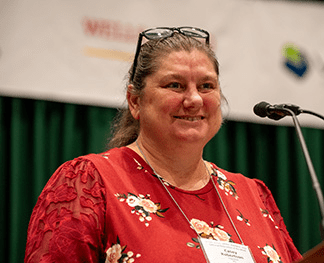
From the Editor: This presentation discusses one of our most important responsibilities, that being to educate blind students so they are in a position to be confident, contributing adults. That is the goal, but what is the path we must travel to achieve it? What follows are the remarks of someone who has some clear ideas to answer that question.
I am always moved when people who work in the blindness field also consider themselves as a part of us, and we have no finer example than Casey. She shares what she has learned from the education system with us and what she has learned from us with her fellow educators and students. Here is what she said to the 2024 National Convention on July 6:
[A song plays as Casey walks to the stage] Thank you, President Riccobono, and I’m glad you chose a different song besides “My Tractor’s Sexy.” I’m glad the song was different.
I am Casey Robertson, and I’m the lead instructor at the Professional Development and Research Institute on Blindness at Louisiana Tech. Now, that’s a mouthful, so we just call ourselves PDRIB [pronounced pid rib]. We have existed since 1999.
The Institute on Blindness provides outstanding professional preparation for individuals entering the field and working with blind children and adults, and our graduates have been eagerly sought after by employers from across the United States in both the public and private sector. We have some graduate students here, and they were swarmed the first night because people want to hire them.
We train individuals in four pathways to reach certification to work in the field of blindness, and we do that training based on the Structured Discovery method of teaching. [Applause] I am also an advocate for blind students and their families across the nation. Those families who are seeking services are seeking better services to provide independence for their blind children. Some of those families are here in the room with us today.
I also love volunteering my services to the National Federation of the Blind in any capacity that is needed. But if you really know me, if you really, really, know me, besides tractor riding, I am an educator at heart. I love people, and I love literacy for all people.
I want to take a moment and share a story with you. This story is adapted from a children’s book by Amanda Gorman, a best-selling author. The title is Something Someday.
You are told that there is not a problem. But you’re sure in your heart and in your gut that there is a problem. You are told that you cannot fix that problem, but you know that you can help. You are told that this is too big for you. It is a very, very big problem. But you have seen the tiniest of things make a huge difference before. You’re told that this won’t work, so don’t even try. But how will you know if you never try?
You’re told to sit and wait, but you know people have waited for far too long. You’re told that what is going on is very, very sad, but you’re not just sad; you’re scared, you’re confused, and maybe you are downright angry. And maybe, just maybe, underneath all of that, you’re also hopeful. You are told not to hope too much, because there’s no use to hope. But you keep hoping anyway.
Sometimes you may feel that you’re all alone, but someday, somewhere, you find a friend—someone who will help you and who believes in your dream, someone who will fight with you. You make a promise to each other, and you say, “This is a problem, but it’s our problem together, so we can fix it together. The problem is big, but together we are bigger.”
So together, working, and together, beginning, over and over again you keep at it, until you are no longer beginning. You are now winning. Suddenly there is something you’re sure is right. Something you know has helped—something small that has changed things in a big way, something that is no longer a dream, but the day that that dream becomes a reality that you live in.
I share this book with you because it describes the direction of the education of blind students in our country as we speak. It also describes how I feel so often in the field of blindness.
Just as the little boy in the story identified, we have several issues that just do not seem right. Currently, students are not receiving enough Braille. We have a shortage of teachers in the field and a great number of teachers who are in the field lack the self-efficacy to teach Braille literacy to their students. Schools are not equipped to provide services, or they just feel that they don’t have to provide services. Sometimes they even feel that just good enough is good enough; we don’t need to do any more.
Parents do not have the advocacy that they need to advocate for students. Society, along with the educational system, has set very low standards for our students based on their lack of knowledge. Research has proven that literacy is more than just reading and writing. At its simplest form, literacy is the way that we interact with the world around us, how we shape it, and how it shapes us. It is how we communicate with others via reading and writing, but also speaking and listening and creating. It is how we articulate our experiences in this world.
Literacy has a direct impact on employment: better access to the economy, better opportunities, and even better nutrition and environmental stability. However, just as the little boy in the story was told “there is no problem,” parents are often told there is no literacy problem with their child. Educational staff, along with professionals in the field, will state that the student is receiving the best education the school can offer. And, after all, parents, you should just expect your blind kids to be slower and perform with less ability than their sighted peers. [Audience responds with boo] That’s right! Boo! When parents are told there is no problem, deep in the heart of the parents, they are sure that they know something is wrong. It’s not okay for a third grader to be illiterate, not being able to read or write or express themselves in a creative way just because they are blind. [Applause] So, you may ask, why would professionals in the field of blindness tell families this type of misinformation? I believe it flows back to our teacher preparation programs.
Just as the little boy in the story was told, in the teacher preparation sphere, we recognize that there are problems. We can even state those problems. Others in the sphere would tell us the problems are too large for us to solve. It is often stated that the problems are just way too large, because there’s not enough teachers, not enough funding, not enough time and, after all, Braille is too hard to learn, too hard to teach, and has so many rules. And, does anybody use Braille any longer?
So as I stand here before you today and say these problems go back to the teacher preparation program, let me share my evidence of how I came to this conclusion. Let’s look at literacy requirements of the teacher preparation program. Currently, there are thirty-eight universities across the country that have teacher preparation programs for teaching blind students. Most of them, outside of Louisiana Tech, call it “Teaching Visually Impaired.” The programs make up both graduate and undergraduate studies.
Research as recent as 2022 showed that the Braille code competency is not consistent among universities, thus resulting in inconsistent expectations of those teachers that they are turning out into the field. Most of the thirty-eight universities do not ask their teachers to show any Braille proficiency at the end of the program. Those that do show proficiency set a very low reading rate of approximately twenty words per minute to pass their course.
In a 2019 study of undergraduate programs, teachers of the blind showed that 31 percent of the universities that offered Braille only offered one course in Braille. Teachers and personnel preparation programs are taught that Braille readers will read one-third to one-fifth the rate of their sighted peers. Some of the universities are even teaching their teachers to accept that students will read one-half to two times slower than their sighted peers.
When we look at Nemeth, the math code for Braille, Amato examined colleges and universities that prepared teachers of the blind. She found that almost all teachers that she interviewed had had a course in Nemeth. However, they still felt their skills to teach Nemeth were inadequate. We know by research that if a teacher does not have the self-efficacy to teach a subject such as Braille or Nemeth, they are not going to recommend a student learn it. After all, if a teacher doesn’t know Spanish, do you think she is going to take a job teaching Spanish?
Currently we do not—I repeat do not—have any national standards for what teachers of the blind are taught. Each university can apply their bias and expectations and determine what they will or will not teach. How can we expect our students to have a consistent education if we are not training our teachers in a consistent format with the same high expectations?
In the teacher preparation arena, I am often told that the problems are too large for me to solve. It’s too large for any university to solve. We are often told the problems are so large because, once again, there are not enough teachers, not enough funding, and not enough time. Just as the little boy in the story was discouraged from solving the problem he knew existed, he was told to sit and wait. Well, I stand here today and tell you: blind people are met with daily access challenges that society has, and they say are minor problems. Blind people are asked to sit and wait, and we have waited far too long. [Cheers and applause]
When I came into the field of blindness education many years ago, I was told that the problem in the blindness field was so large and had been going on so long that I could expect them to be here long after I was pushing up daisies. I was encouraged to not rock the boat, and let it float with the status quo. I was also encouraged to not educate the populous. While on the one hand that might have been advice to pace my work, at the same time it was an expectation that things would not change in the education of blind children. It was a negative expectation of a cycle that has gone on far too long for our blind children. [Applause]
Just like the little boy in the story, I was simply not going to sit and wait for a change. [Applause] So I found partners who believed in my dream. I found the National Federation of the Blind. [Cheers and applause]
So you might ask, what does it take to create that change in the teacher preparation program? It takes listening to blind people and valuing their words. It takes partnering with the organized blind movement, the NFB, to find out what teachers need to know to be able to teach children. In a majority of the programs across the United States that have teacher preparation programs, teachers never meet a blind person before they graduate.
We should be at the forefront of the education for blindness, because we are the organized blind movement. We are the ones who know what it takes to create a successful blind person. We don’t need people to tell us what we have to have to create a successful blind person. We know that. It also takes courage to step out of your comfort zone and be a leader in the field, even when the other entities, including universities, are telling you it will not work.
In December [2023], I traveled to a convention with a colleague of mine who is blind. We were met with less than a warm welcome, and every time the professionals in the blindness field saw us coming, they would quickly dart the other way. So the field is not as warm to blindness as it should be.
At Louisiana Tech, through the Office of Professional Development and Research Institute on Blindness, we know, just as the little boy in this book knew, that taking action, one small step at a time, telling others and partnering with them would be the best start to a solution. In our teachers of blind students’ program, we partner with the Louisiana Center for the Blind, [Cheering] and we expose our graduate students to some of the highest-quality Structured Discovery training that exists.
At the university, we set the highest requirements for Braille in the nation. Now, you remember the other universities had a mere twenty words per minute if they had any proficiency at all to graduate. My students leave our program reading a minimum of one hundred words per minute in Braille. [Cheers and applause]
At a conference I recently attended, I sat at the table to share dinner with teacher preparation personnel across the nation, and they all told me these standards were not needed, that no one needed to read Braille at one hundred words per minute to be able to teach kids. Because if they had any sight, we didn’t need to teach them Braille. They went on to tell me that teachers in the field had full-time jobs, so why would I make them do ten pages of Braille homework a week? I told them that that is what I had found necessary to show proficiency and for them to retain the code. My message was not well received among the professionals.
Not only do our students leave the program reading one hundred words per minute; almost all of them hold the National Certification in Unified English Braille before graduating. [Applause] At that table that night, I mentioned that all of my students take the NCUEB, and it was met with the question of, “Why should they have to show proficiency to teach Braille?” So needless to say, they didn’t buy my dinner that night.
We employ the Structured Discovery method of teaching throughout our programs. We teach teachers how to teach literacy and orientation and mobility to blind students. We give them the self-efficacy needed to go out and to not be afraid to teach blind students. Recently, in one of the Monarch trainings, several of my students were in that training, and I was getting text messages. “Hey, we can read the Braille without the screen on, and all the other teachers need the screen.” [Audience chuckling] I enjoyed those text messages.
When our students complete our program, they know Braille is not too hard. It’s not too hard to learn, it’s not too hard to teach, you can learn the rules, and it is still used by blind people. [Applause]
We could not solve the problem alone, though. We have to have partners. So we recently partnered with the National Federation of the Blind of Maryland and the Maryland Department of Education to train a cohort of fifteen teachers from Maryland to go back into the state and teach Braille literacy to students. [Cheers and applause] All of those teachers hold the NCUEB.
Because of this dramatic increase of teachers of blind students in Maryland, this past school year was the first year that the Maryland School for the Blind was able to meet required service minutes for their school districts. [Applause] These teachers filled a huge void in the education of students with blindness in Maryland.
If we want students to receive a quality education and the excuse is the shortage of teachers, then we need your help—everyone in this room. I need your help in recruiting more teachers and more people to go into the teaching of blind students just as Maryland did. [Applause] We would love to train more blind people to go in the field of education. Find a cohort in your state, get with me, and let’s educate them. [Applause]
While training teachers is important, we also need to train the paraprofessionals, because, you know, most of our students sit with a paraprofessional more during the day than they do a teacher of blind students. Parents also need to know Braille to be able to assist their students with homework and to know that, when a teacher says it will take a year to learn letters A through J in the Braille alphabet, something is wrong.
Three years ago we decided to train parents and paraprofessionals at our office at PDRIB. This class is a fourteen-week class offered over the summer, and it’s particularly targeting paraprofessionals and parents. The first year we had three members. Two of those members received their National Certification in Unified English Braille. The third entered the teaching program. This class has now grown from three members that first summer to twenty participants this summer.
I was once again met with educators across the field wanting to know why I was doing more. “Why are you doing this for parents and paraprofessionals?” “Where is the funding coming from?” “There’s no way you’ll be able to do this without funding.” So I let them know we were volunteering our services and that the parents get it free.
We also recently partnered with the NFB and the Lavelle Fund to train sixteen IEP advocates to go out and train others to represent students in IEP meetings. There will be an additional IEP cohort coming next year. This will have a trickledown effect as we train the advocate, the advocate goes and trains more advocates, and the education spreads.
Our office at the university offers student assessments across the nation to make sure that they have quality services. Recently, with some informal research on social media, I asked parents of blind students and blind students alike to tell me what they wish their teacher of blind students knew. Some of the responses I received were: “I wish that my teacher had not been my friend but been my teacher.” “I wish they had pushed me harder.” And I think the most heartbreaking statement was from a three-and-a-half-year-old who said, “Please come see me more. I know I can learn to read.” We know these small steps have been taken at the university with our partners, and we know that they are the right steps to create change in a big way.
So as I close my speech and time with you today, I want to leave you with the thoughts of the little boy from our read-aloud. We need our dream of every blind student being a successful adult to come true. We need people like you to dream and dream big. We need you to recruit others to believe in our dream so that someday something will happen, and our dream will become reality.
Thank you!
 Natural Order of Contractions
Leave a comment